
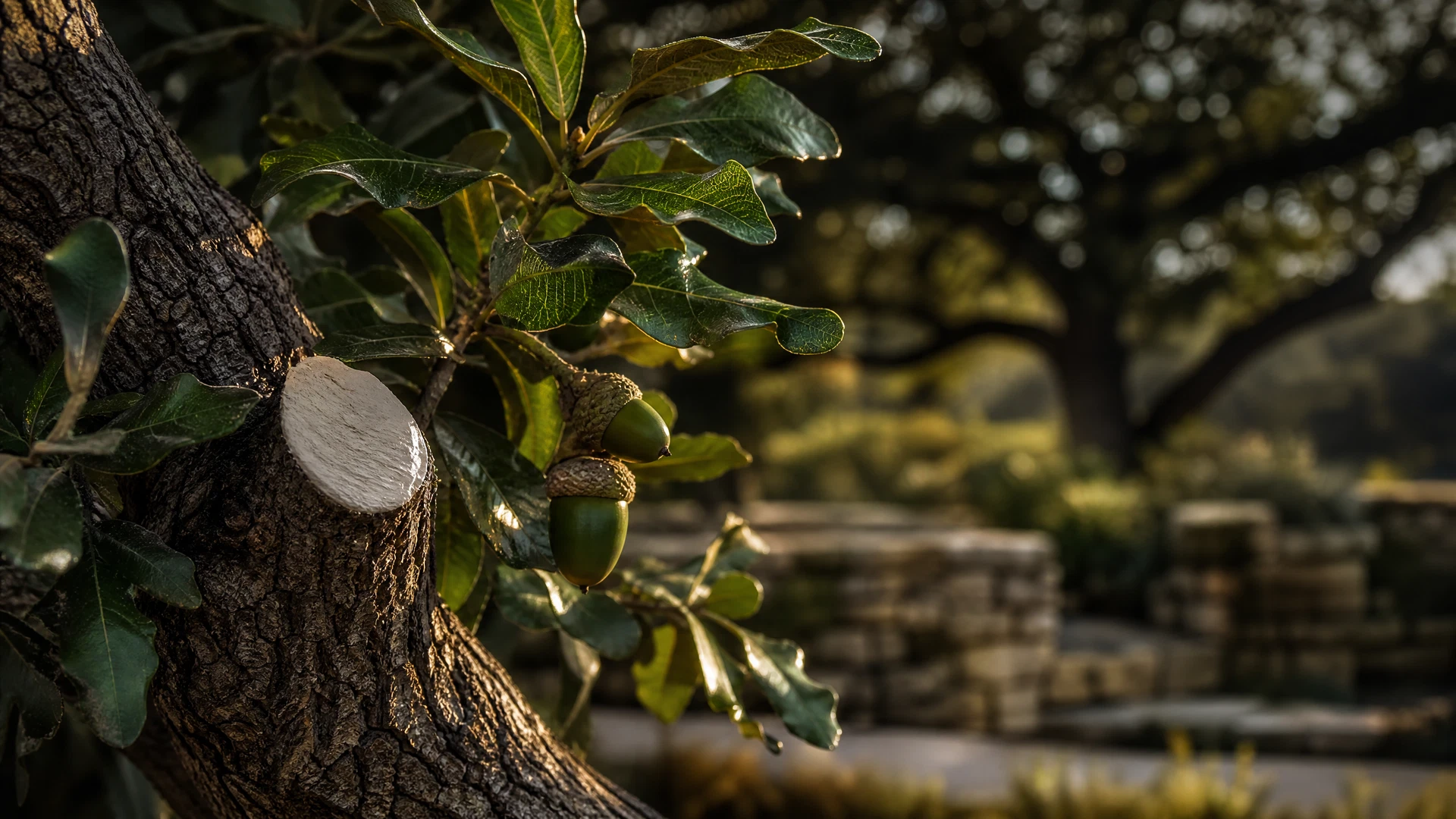
Oak wilt guidance for Central Texas homeowners
Oak wilt in Central Texas
Oak wilt can move quickly through Central Texas oaks. This guide covers prevention, the February through June no-pruning window, fresh-wound painting, connected root systems, symptoms, wood handling, and where to seek authoritative technical help.
Central Texas / oak wilt reference
Oak wilt guidance is most useful when paired with the tree, season, and surrounding canopy in front of you. This reference separates prevention practices from diagnosis and treatment claims.
01
What oak wilt is — the facts separated from advice
Oak wilt is a disease produced by the fungus Bretziella fagacearum. It attacks the vascular system of oaks and can kill susceptible trees in a single season on red oaks. These are established scientific facts; the Texas A&M Forest Service summarizes the biology and risk factors clearly at Texas A&M Forest Service oak wilt guidance and Texas A&M Forest Service spring oak guidance.
This page separates those facts from practical homeowner choices. Facts: all oak species can be infected; susceptibility varies by group (red, live, white). Advice: how you prune and move wood changes your risk. Where treatments exist, this page will point you to Texas A&M Forest Service or an appropriately qualified provider rather than offering or endorsing treatments here.
02
Which oaks are most at risk and how they behave
Red oak group trees—shallow‑lobed leaves, rapid decline—are the most vulnerable. If infected, they often show rapid leaf browning and can die quickly in the growing season. Live oaks (often called Texas live oak or Quercus fusiformis) are intermediate: they can decline more slowly and sometimes show patchy symptoms. White oaks tend to be the least susceptible but are not immune.
On live oaks you may see yellowing or brown discoloration running along the leaf veins; that symptom can indicate oak wilt infection, but it can also be caused by drought, root issues, or seasonal leaf exchange. Because seasonal leaf drop can mimic disease, observe timing and pattern: sudden, widespread vascular browning in mid‑spring or summer, especially when multiple nearby oaks decline, raises concern.

Property note
Reading the guidance against your own trees
Guidance is most useful when it helps a property owner ask a better question, recognize a reason to pause, and return to primary sources when conditions require confirmation.
03
How oak wilt spreads and the critical calendar for Central Texas
There are two principal pathways for oak wilt spread. Above ground, sap‑feeding beetles and other insects are attracted to fresh wounds and can carry fungal spores from an infected tree to a healthy wound. Underground, the fungus can move from tree to tree through root grafts where oaks share a connected root system. Both pathways are important in Central Texas neighborhoods where oaks grow close together.
Because beetle activity and the risk of transmission from fresh wounds are highest in the spring, Central Texas homeowners should avoid pruning or otherwise wounding oaks during the high‑risk window. The widely recommended no‑pruning period is February through June; this timing comes from the Texas A&M Forest Service guidance (see Texas A&M Forest Service oak wilt guidance). Year‑round action you can take: immediately paint every fresh oak wound with a water‑based pruning paint or asphalt emulsion to reduce beetle attraction.
04
Practical prevention and yard practices that reduce risk
The simplest, most reliable prevention steps are behavioral: avoid wounds during Feb–Jun, paint all fresh wounds immediately, do not move oak firewood or debris from properties with suspect oak decline, and keep a defensible distance between oak crowns where practical. Moving infected wood is a common way oak wilt moves to new areas; if you harvest or use firewood, keep it local and avoid bringing unknown oak wood onto your property.
On the maintenance side, promote tree vigor through proper watering, mulching, and avoiding soil compaction. Vigor helps trees tolerate a range of problems, though it won’t make them immune to oak wilt. For more detail on prevention and community outreach materials, Texas A&M Forest Service and the non‑profit Texas Oak Wilt Partnership maintain guidance at Texas Oak Wilt Partnership guidance and the TFS links above.
05
If you suspect oak wilt: sensible next steps and decision boundaries
If you notice suspect symptoms—rapid, wilting leaf discoloration on red oaks, vein‑following browning on live oaks, or multiple nearby trees declining—start by isolating the potential pathways of spread. Don’t move firewood or pruning debris off the property. Do not prune oaks or cut into suspected trees until you have confirmed the situation with a qualified resource. Do not rely on a definitive diagnosis from a single photograph; lab confirmation and field inspection are often needed.
For diagnostic guidance, referral options, and technical recommendations that go beyond home remedies, consult Texas A&M Forest Service or an appropriately qualified provider. This page does not offer treatment or injection advice. Your local county forester or the TFS pages are the proper referral points — see Texas A&M Forest Service oak wilt guidance for contact directions. If work involves trees near energized utility lines, that work belongs to the utility; call the utility before anyone attempts removals or major limb work.
06
How local tree crews work with homeowners in the Austin I‑35 corridor
Properties from Georgetown through Manor and south to Manchaca and Buda share common oak species and the same seasonal risk window. A competent crew’s role is practical: identify visible symptoms, advise on containment steps (do not move suspect wood, paint fresh wounds), and perform safe removals or pruning outside the Feb–Jun window when necessary. For homeowners who want an on‑site assessment, call (512) 387-2671 to schedule an inspection and request a written quote. An on‑site look clarifies whether crowns are connected below ground to neighbor trees, whether removal is necessary for safety, and what disposal options are available for the wood.
Work-planning drivers in Central Texas are predictable: tree size and weight, access difficulty (fences, slopes, overhead utilities), distance to disposal sites, and timing relative to the pruning restriction window. If a suspect tree requires removal outside the high‑risk window, crews take extra containment steps like immediate limb painting and controlled chipping; if work must touch lines, the utility is involved and that changes the logistics. A written quote lays out scope, timeline, and disposal options so you can compare choices.
Primary references
Check the source.
Municipal requirements and oak-wilt guidance can change. These are the official sources used for this page.
Considered answers
Straight answers about oak wilt
What causes oak wilt and which oaks are affected?
Oak wilt is caused by the fungus Bretziella fagacearum. It can infect all oaks, but susceptibility varies: red oaks are the most susceptible and can die quickly, live oaks have intermediate susceptibility, and white oaks are the least susceptible but not immune. These are established facts summarized by the Texas A&M Forest Service (see Texas A&M Forest Service oak wilt guidance).
How does oak wilt spread on my property?
There are two main pathways. Above ground, sap‑feeding beetles and other insects carry spores from fresh wounds on infected trees to fresh wounds on healthy trees. Underground, the fungus can travel through connected root grafts between adjacent oaks; the connected root system can carry risk beyond one trunk. That combination is why both wound prevention and avoiding root connections (where practical) are part of risk management.
How can I tell oak wilt from normal seasonal leaf drop or drought stress?
On live oaks, oak wilt can produce yellow or brown discoloration that follows leaf veins. However, seasonal leaf exchange and drought stress can look similar. Key differences are suddenness and pattern: oak wilt often causes rapid, widespread decline across multiple nearby trees, especially in red oaks. If you’re unsure, document symptoms and contact Texas A&M Forest Service or your county forester for guidance rather than relying on a single photo for diagnosis.
When is it safe to prune my oaks?
Avoid pruning or creating wounds on oaks from February through June in Central Texas. Outside that window you still must paint fresh wounds immediately to reduce beetle attraction. If you have urgent hazards during the restricted months, contact the utility for work near lines and consult a qualified crew for safe options.
If I suspect oak wilt, who should I contact for technical guidance?
This page is educational only and does not provide diagnosis or disease services. For diagnostic guidance and referral options, contact the Texas A&M Forest Service or an appropriately qualified provider; TFS maintains guidance pages at Texas A&M Forest Service oak wilt guidance and Texas A&M Forest Service spring oak guidance. The Texas Oak Wilt Partnership (Texas Oak Wilt Partnership guidance) is also a reliable resource. Do not move wood off the property while you pursue a diagnosis.
Private assessment
Begin with the property.
Tell us where the tree stands, what changed, and what it could reach. We will clarify the next step before work begins.
For urgent work, call (512) 387-2671